Buy fallback.eu ?
We are moving the project
fallback.eu .
Are you interested in purchasing the domain
fallback.eu ?
domain@kv-gmbh.de · 0541-91531010
Buy fallback.eu ?
What is the relationship between escape velocity and wavelength shift?
Escape velocity is the minimum velocity needed for an object to break free from the gravitational pull of a celestial body. When an object is moving at escape velocity, it will experience a shift in its wavelength due to the gravitational redshift effect. This means that as an object moves away from a massive body at escape velocity, its wavelength will be stretched, causing a redshift in the observed light. **
How do you calculate the escape velocity using the integral of work?
To calculate the escape velocity using the integral of work, you can use the work-energy principle. The work done on an object to move it from the surface of a planet to infinity is equal to its change in kinetic energy. By integrating the work done against gravity from the surface to infinity, you can find the total work done. Setting this equal to the change in kinetic energy and solving for the velocity will give you the escape velocity. This method takes into account the gravitational potential energy and allows for the calculation of the velocity required for an object to escape the gravitational pull of a planet. **


Similar search terms for Escape velocity
Top-Angebote
Products related to Escape velocity:
-
Velocity Pro Gear Velocity Rogue 50 Tool BagVelocity Rogue 50 Tool Bag – Premium Trades Backpack with LED Light The Velocity Rogue 50 Tool Bag is the next level of professional tool organisation. Built for serious tradespeople who need durability, structure and rapid access to tools, the Rogue 50 combines cutting edge design and site-ready performance. Packed with clever storage, this backpack has 36 internal & external pockets, vertical tool organisation, a removable tool panel and a rear section with a Velcro tool holder for your essentials. The removable 150-lumen LED light means you can work in dark or confined spaces with ease. The Rogue 50 has a quick-release magnetic harness system, heavy-duty backpack straps and a thermoformed comfort panel to reduce fatigue on long days.229,00 £*Shipping: 0,00 £Secure redirect to the provider
-
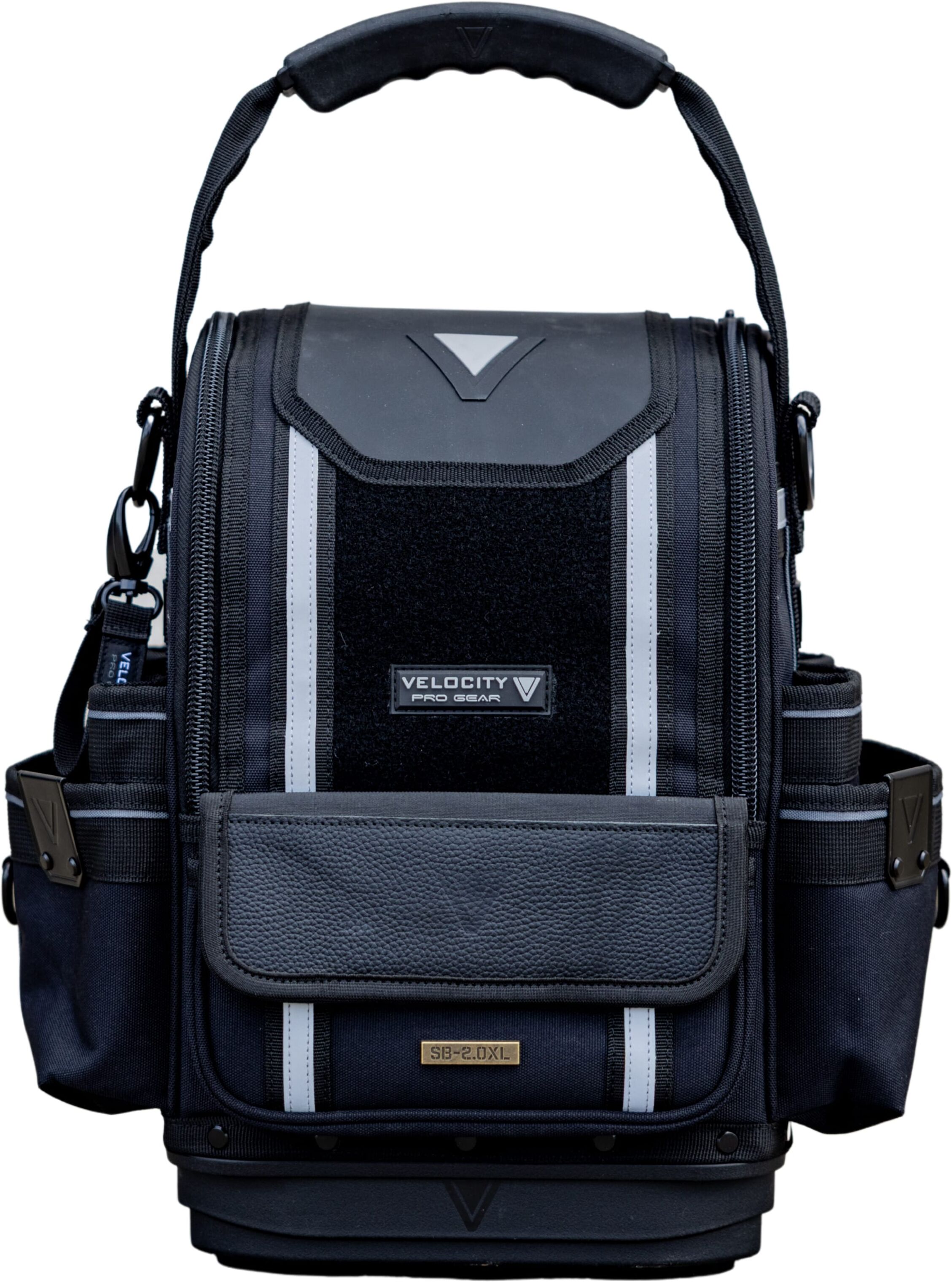
Velocity Pro Gear Velocity Rogue 20XL Service BagVelocity Rogue 20XL Service Bag – Black (SB-20XL-S) A service bag earns its keep when you can find the screw you need without emptying it. The Velocity Rogue 20XL is the larger version of Velocity’s 2.0 Service Bag, with 37 internal and external pockets, a removable tool panel and three embedded magnets on the internal lid. The magnets sit above a larger clear pocket, so screws and fittings stay at hand. The removable tool panel has four pockets, so you can carry your most-used tools separately without digging through the main bag. There’s a rear paperwork or tablet pocket, four external D-rings, an internal velcro holder for tool kits, a front easy-access pouch and a rubber front profile with a large velcro section for customising. Two tape mount holders sit on the external pockets, and reflective strips on the front and side improve visibilit167,00 £*Shipping: 0,00 £Secure redirect to the provider
-
Velocity Pro Gear Velocity Rogue 80XS Tool BagVelocity Rogue 80XS Tool Bag – Soldering & Service Tote The Velocity Rogue 80XS Tool Bag has all the great features of the Rogue 80 in a more compact package — perfect for professionals on the move. Made from 900D PVC-backed nylon, reinforced with industrial-strength stitching and finished with a rugged 3mm polypropylene waterproof base, this bag is built to withstand the toughest daily trade environments. With dedicated pockets for soldering essentials — including a blow torch head pocket, pipe slice dock (15mm / 22mm / 28mm) and removable gas bottle holder — the Rogue 80XS is super efficient and organised in a lighter, more portable format. FEATURES & BENEFITS 900D PVC-Backed Nylon – Tough, water-resistant outer ma170,00 £*Shipping: 0,00 £Secure redirect to the provider
-
Velocity Pro Gear Velocity Rouge 70 Kit BagVelocity Rogue 70 Kit Bag - 20 Tool Kit Bag Velocity teamed up with PB Plumber to give birth to the Rogue 70, a game-changing kit bag that essentially takes the 7.0 and gives it a serious make-over. This 20 inch, 1200D water-resistant beast weighs in at 5.2kg and has an impressive 34 internal and external pockets to keep your tools and bits and bobs neatly in check. There's dual removable tool panels, a removable moulded container, a rear section for the heavy stuff, spirit level holder, tape holder, a protective work mat and a 3.2mm waterproof base all crammed into one very practical kit bag. The Rogue 70 is the result of a couple of chaps who use kit bags on the job all the time sitting down and having a think about what should really be included in one. The big open central section can take your bigger tools and peripherals that won't fit in the201,00 £*Shipping: 0,00 £Secure redirect to the provider


-
Do you really need escape velocity to leave the Earth's gravitational field and reach outer space?
No, you do not necessarily need to reach escape velocity to leave Earth's gravitational field and reach outer space. Escape velocity is the minimum speed an object needs to reach in order to break free from the Earth's gravitational pull. However, spacecraft can use other methods such as continuous propulsion or gravitational slingshots to gradually increase their altitude and eventually reach outer space without reaching escape velocity. Therefore, while escape velocity is one way to leave Earth's gravitational field, it is not the only method. **
-
Is there a precursor to a black hole that has an escape velocity just below the speed of light?
Yes, there is a precursor to a black hole known as a neutron star. Neutron stars are extremely dense remnants of massive stars that have undergone a supernova explosion. Neutron stars have escape velocities close to the speed of light, but they are not black holes because their gravitational pull is not strong enough to prevent light from escaping. If a neutron star were to collapse further under certain conditions, it could potentially become a black hole with an escape velocity exceeding the speed of light. **
-
How are linear velocity, angular velocity, and frequency related?
Linear velocity, angular velocity, and frequency are all related through the equation v = ωr, where v is linear velocity, ω is angular velocity, and r is the radius of the rotating object. Angular velocity is the rate at which an object rotates around a fixed point, while linear velocity is the rate at which an object moves in a straight line. Frequency is the number of complete rotations or cycles per unit of time and is related to angular velocity by the equation f = ω/2π. Overall, these three quantities are interconnected and can be used to describe the motion of rotating objects. **
-
What is the difference between instantaneous velocity and average velocity?
Instantaneous velocity refers to the velocity of an object at a specific moment in time, while average velocity is the total displacement of an object over a given time interval divided by the total time taken. Instantaneous velocity gives us information about the object's velocity at a particular instant, while average velocity provides an overall picture of the object's velocity over a period of time. In essence, instantaneous velocity is like looking at a snapshot of an object's motion, while average velocity is like looking at the entire video. **


What is instantaneous velocity?
Instantaneous velocity is the velocity of an object at a specific moment in time. It is the rate at which an object's position changes with respect to time at a particular instant. Unlike average velocity, which is calculated over a period of time, instantaneous velocity provides information about an object's speed and direction at a single point in time. **
What is enzyme velocity?
Enzyme velocity refers to the speed at which an enzyme catalyzes a specific chemical reaction. It is a measure of how quickly the enzyme converts substrate into product. Enzyme velocity is often determined by measuring the rate of formation of the product or the rate of disappearance of the substrate over a specific period of time. This velocity is influenced by factors such as enzyme concentration, substrate concentration, and temperature. **
Top-Angebote
Products related to Escape velocity:
-
Velocity Pro Gear Velocity Rogue 45 Backpack – BlackVelocity Rogue 45 Backpack – Black All the build quality of the Rogue 50, but in a lighter, more compact package. The Velocity Rogue 45 Backpack, in Black, weighs in at 3.75kg, and has 29 external and internal pockets, a removable 150-lumen LED light, a quick-release magnetic harness, M10 YKK zippers, a 3.2mm waterproof base and a 14-inch laptop sleeve - essentially a serious site organisation system minus the full Rogue 50 footprint - for people who want all the functionality of the bigger bag without the bulk. The Rogue 45 doesn't skimp on quality just to be smaller - it's the Rogue 50 spec condensed into a lighter, more compact format for tradespeople who prefer a lighter load or work in cramped conditions. Yep, it still has 20 vertical tool pockets and two pouches in the main compartment, the same removable tool panel and velcro tool set holder198,00 £*Shipping: 0,00 £Secure redirect to the provider
-
Velocity Pro Gear Velocity Rogue 80 Soldering BagVelocity Rogue 80 Soldering Bag – Shadow Black (OT-80-B) Soldering kit is awkward to carry: a gas bottle, burner, flux, rag and heat mat all need somewhere to go, and none of it should rattle around loose. The Velocity Rogue 80 is a soldering bag with a place for each: a gas bottle holder, a rear open pocket for the burner, a removable wet rag pot, a removable flux brush holder, a pipe slice docking station, a fire extinguisher holder and a large leather front pocket for a heat mat. Vertical tool pockets and corner pockets keep longer tools and pipe off-cuts to hand, and a central compartment takes peripherals. The outer is 1200D water-resistant fabric on a 3.2mm polypropylene waterproof base, with industrial-strength nylon stitching and marine-grade rivets. A heavy-duty padded shoulder strap and a rubber ergonomic carry handle make it comfortable193,64 £*Shipping: 0,00 £Secure redirect to the provider
-
Velocity Pro Gear Velocity Rogue 50 Tool BagVelocity Rogue 50 Tool Bag – Premium Trades Backpack with LED Light The Velocity Rogue 50 Tool Bag is the next level of professional tool organisation. Built for serious tradespeople who need durability, structure and rapid access to tools, the Rogue 50 combines cutting edge design and site-ready performance. Packed with clever storage, this backpack has 36 internal & external pockets, vertical tool organisation, a removable tool panel and a rear section with a Velcro tool holder for your essentials. The removable 150-lumen LED light means you can work in dark or confined spaces with ease. The Rogue 50 has a quick-release magnetic harness system, heavy-duty backpack straps and a thermoformed comfort panel to reduce fatigue on long days.229,00 £*Shipping: 0,00 £Secure redirect to the provider
-
Velocity Pro Gear Velocity Rogue 20XL Service BagVelocity Rogue 20XL Service Bag – Black (SB-20XL-S) A service bag earns its keep when you can find the screw you need without emptying it. The Velocity Rogue 20XL is the larger version of Velocity’s 2.0 Service Bag, with 37 internal and external pockets, a removable tool panel and three embedded magnets on the internal lid. The magnets sit above a larger clear pocket, so screws and fittings stay at hand. The removable tool panel has four pockets, so you can carry your most-used tools separately without digging through the main bag. There’s a rear paperwork or tablet pocket, four external D-rings, an internal velcro holder for tool kits, a front easy-access pouch and a rubber front profile with a large velcro section for customising. Two tape mount holders sit on the external pockets, and reflective strips on the front and side improve visibilit167,00 £*Shipping: 0,00 £Secure redirect to the provider
-
What is the relationship between escape velocity and wavelength shift?
Escape velocity is the minimum velocity needed for an object to break free from the gravitational pull of a celestial body. When an object is moving at escape velocity, it will experience a shift in its wavelength due to the gravitational redshift effect. This means that as an object moves away from a massive body at escape velocity, its wavelength will be stretched, causing a redshift in the observed light. **
-
How do you calculate the escape velocity using the integral of work?
To calculate the escape velocity using the integral of work, you can use the work-energy principle. The work done on an object to move it from the surface of a planet to infinity is equal to its change in kinetic energy. By integrating the work done against gravity from the surface to infinity, you can find the total work done. Setting this equal to the change in kinetic energy and solving for the velocity will give you the escape velocity. This method takes into account the gravitational potential energy and allows for the calculation of the velocity required for an object to escape the gravitational pull of a planet. **
-
Do you really need escape velocity to leave the Earth's gravitational field and reach outer space?
No, you do not necessarily need to reach escape velocity to leave Earth's gravitational field and reach outer space. Escape velocity is the minimum speed an object needs to reach in order to break free from the Earth's gravitational pull. However, spacecraft can use other methods such as continuous propulsion or gravitational slingshots to gradually increase their altitude and eventually reach outer space without reaching escape velocity. Therefore, while escape velocity is one way to leave Earth's gravitational field, it is not the only method. **
-
Is there a precursor to a black hole that has an escape velocity just below the speed of light?
Yes, there is a precursor to a black hole known as a neutron star. Neutron stars are extremely dense remnants of massive stars that have undergone a supernova explosion. Neutron stars have escape velocities close to the speed of light, but they are not black holes because their gravitational pull is not strong enough to prevent light from escaping. If a neutron star were to collapse further under certain conditions, it could potentially become a black hole with an escape velocity exceeding the speed of light. **
Similar search terms for Escape velocity
-
Velocity Pro Gear Velocity Rogue 80XS Tool BagVelocity Rogue 80XS Tool Bag – Soldering & Service Tote The Velocity Rogue 80XS Tool Bag has all the great features of the Rogue 80 in a more compact package — perfect for professionals on the move. Made from 900D PVC-backed nylon, reinforced with industrial-strength stitching and finished with a rugged 3mm polypropylene waterproof base, this bag is built to withstand the toughest daily trade environments. With dedicated pockets for soldering essentials — including a blow torch head pocket, pipe slice dock (15mm / 22mm / 28mm) and removable gas bottle holder — the Rogue 80XS is super efficient and organised in a lighter, more portable format. FEATURES & BENEFITS 900D PVC-Backed Nylon – Tough, water-resistant outer ma170,00 £*Shipping: 0,00 £Secure redirect to the provider
-
Velocity Pro Gear Velocity Rouge 70 Kit BagVelocity Rogue 70 Kit Bag - 20 Tool Kit Bag Velocity teamed up with PB Plumber to give birth to the Rogue 70, a game-changing kit bag that essentially takes the 7.0 and gives it a serious make-over. This 20 inch, 1200D water-resistant beast weighs in at 5.2kg and has an impressive 34 internal and external pockets to keep your tools and bits and bobs neatly in check. There's dual removable tool panels, a removable moulded container, a rear section for the heavy stuff, spirit level holder, tape holder, a protective work mat and a 3.2mm waterproof base all crammed into one very practical kit bag. The Rogue 70 is the result of a couple of chaps who use kit bags on the job all the time sitting down and having a think about what should really be included in one. The big open central section can take your bigger tools and peripherals that won't fit in the201,00 £*Shipping: 0,00 £Secure redirect to the provider
-
Velocity Pro Gear Velocity Rogue 45 Backpack – OrangeVelocity Rogue 45 Backpack – Orange (BP-45-O-C) A tool backpack is only worth carrying if it’s not a burden by the end of the day. The Velocity Rogue 45 is a smaller, lighter backpack with many of the features of the larger Rogue 50: 29 internal and external pockets, a removable 150-lumen LED light, a quick-release magnetic harness system and a laptop sleeve, in a bag that weighs 3.75kg. Inside the main compartment are 20 vertical tool pockets and two pouches. At the rear there’s a removable tool panel and a velcro tool set holder, and at the front there’s an EVA pod and a magnetic storage pouch. A thermoformed comfort back panel, heavy-duty foam straps and a top fidlock help carry the load, and a rubber TPR carry handle lets you pick it up. The laptop sleeve takes laptops up to 14 inches, as listed by Velocity UK. The outer is 900D w198,00 £*Shipping: 0,00 £Secure redirect to the provider
-
Velocity Pro Gear Velocity 20M Test Meter BagVelocity Rogue 20M Test Meter Bag – Shadow Black (SB-20M-B) Test meters and probes get scratched and knocked when they’re thrown in with the rest of the tools. The Velocity Rogue 20M takes the Rogue 20XL service bag and adds enclosed, zippered, lined side pockets for meters and test equipment, so your instruments have a pocket of their own. The rest of the bag is the 20XL: 37 internal and external pockets, a removable tool panel with four pockets, embedded magnets under a flap for screws and fixings, and a rear pocket for paperwork or a tablet. The outer is water-resistant, on a 3.2mm polypropylene waterproof base, with M10 YKK interlocking zippers and marine-grade rivets. A rubber front profile with velcro sections lets you customise it with patches and labels, and reflective striping adds visibility. A padded shoulder strap and a rubber ergonom179,00 £*Shipping: 0,00 £Secure redirect to the provider
-
How are linear velocity, angular velocity, and frequency related?
Linear velocity, angular velocity, and frequency are all related through the equation v = ωr, where v is linear velocity, ω is angular velocity, and r is the radius of the rotating object. Angular velocity is the rate at which an object rotates around a fixed point, while linear velocity is the rate at which an object moves in a straight line. Frequency is the number of complete rotations or cycles per unit of time and is related to angular velocity by the equation f = ω/2π. Overall, these three quantities are interconnected and can be used to describe the motion of rotating objects. **
-
What is the difference between instantaneous velocity and average velocity?
Instantaneous velocity refers to the velocity of an object at a specific moment in time, while average velocity is the total displacement of an object over a given time interval divided by the total time taken. Instantaneous velocity gives us information about the object's velocity at a particular instant, while average velocity provides an overall picture of the object's velocity over a period of time. In essence, instantaneous velocity is like looking at a snapshot of an object's motion, while average velocity is like looking at the entire video. **
-
What is instantaneous velocity?
Instantaneous velocity is the velocity of an object at a specific moment in time. It is the rate at which an object's position changes with respect to time at a particular instant. Unlike average velocity, which is calculated over a period of time, instantaneous velocity provides information about an object's speed and direction at a single point in time. **
-
What is enzyme velocity?
Enzyme velocity refers to the speed at which an enzyme catalyzes a specific chemical reaction. It is a measure of how quickly the enzyme converts substrate into product. Enzyme velocity is often determined by measuring the rate of formation of the product or the rate of disappearance of the substrate over a specific period of time. This velocity is influenced by factors such as enzyme concentration, substrate concentration, and temperature. **
* All prices are inclusive of VAT and, if applicable, plus shipping costs. The offer information is based on the details provided by the respective shop and is updated through automated processes. Real-time updates do not occur, so deviations can occur in individual cases. ** Note: Parts of this content were created by AI.